TL;DR
-
OCP (Operational Camouflage Pattern) is the current standard for the US Army, Air Force, and Space Force. It is based on the Scorpion W2 design.
-
M81 Woodland is the classic green and brown pattern used by all branches from the 1980s through the early 2000s. It is still widely used by civilians, hunters, and collectors.
-
MultiCam was developed by Crye Precision and is used by US Special Operations forces. It is not the same as OCP, though the two look similar.
-
MARPAT is the Marine Corps pattern. It comes in woodland and desert versions and is patented by the USMC.
-
Desert camo refers to several patterns built for arid environments, including the three color desert pattern used during Desert Storm and later conflicts.
-
Choosing the right camo for your gear depends on your environment, your branch affiliation, and what you want your kit to communicate.
-
Patches in matching or complementary camo patterns are a straightforward way to personalize gear without breaking uniformity.
Military camouflage patterns are one of the most frequently discussed and least understood topics in the tactical gear community. Most people can easily recognize standard woodland or modern OCP from across a room, but few can explain the structural differences or the history behind why these designs exist. Understanding these variations matters when you are setting up a loadout for duty, preparing for a hunt, or collecting historical gear.
This guide breaks down the major US military camo patterns and explains how they developed, who uses them, and how to select the right one for your kit.
How Military Camouflage Works
Camouflage works by breaking up the visual outline of the human body so it is harder to detect at a distance. Color matching alone is not enough to provide effective concealment. The specific shapes, scale, and contrasts within a pattern matter just as much as the palette itself. Different operating environments require entirely different patterns, meaning a configuration that hides a user in a dense forest will stand out sharply in a sandy desert.
The US military developed branch specific and environment specific patterns over decades, driven by lessons learned during active combat operations. No single pattern works perfectly in every environment, which explains why so many distinct designs exist today.

The Classic M81 Woodland
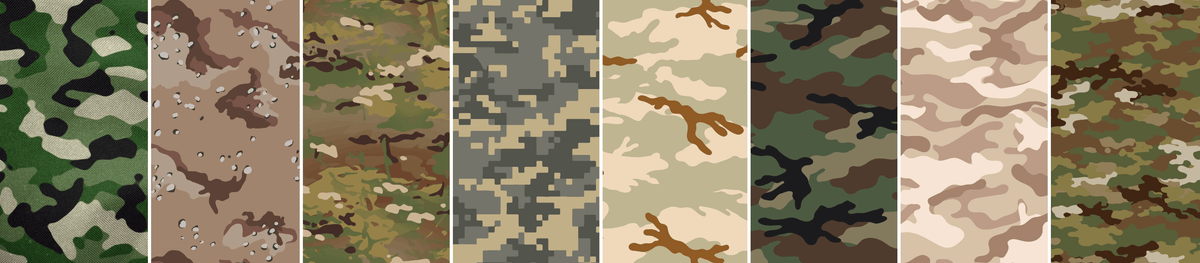
M81 Woodland is a four color camouflage pattern introduced in 1981 and used as the standard US military uniform pattern for nearly two decades. The pattern uses black, dark green, medium green, and brown in irregular, overlapping shapes designed to replicate the look of a temperate forest floor. M81 replaced the earlier ERDL pattern by enlarging the print shapes to provide better concealment at typical combat distances. It became the standard across all branches of the US military, including the Army, Marines, Navy, and Air Force, throughout the 1980s and 1990s.
This battle dress uniform pattern showed its limitations during Desert Storm, where its dark greens stood out sharply against open sand terrain. That tactical gap drove the rapid development of desert specific patterns. The Marine Corps eventually phased out M81 with the introduction of MARPAT in 2002, and the Army replaced it with UCP in 2004.
M81 woodland camo remains extremely popular with civilians, hunters, collectors, and airsoft players for its proven performance in dense foliage and its iconic heritage look.
Desert Camo for Arid Environments
The US military developed specialized patterns to protect troops operating in barren, sandy locations. Two primary variations defined the late twentieth century.

Three Color Desert (DCU)
The three color desert pattern, formally known as the Desert Camouflage Uniform (DCU), uses brown, tan, and pale green shapes on a sand colored base. It replaced the older six color pattern after operations in Desert Storm highlighted the need for a lower contrast design. Three color desert served as the standard desert uniform through the 1990s and early 2000s, seeing widespread use in Iraq and Afghanistan before OCP and MultiCam took over.

Six Color Desert (DBDU – “Chocolate Chip”)
The six color desert pattern, nicknamed chocolate chip for its black pebble shapes, was the first US military desert specific pattern. It was used during Desert Storm in 1991 and remained in limited use through the 1990s. The pattern is no longer issued for active duty but remains a highly recognizable piece of Gulf War era military history that is popular among collectors.

UCP: The Pattern That Did Not Work
UCP (Universal Camouflage Pattern) was adopted by the US Army in 2004 as a single pattern intended to work across woodland, desert, and urban environments. The pattern used a digital pixelated design in shades of gray, tan, and light green. UCP performed poorly in field testing and combat use because its gray heavy palette stood out against the green terrain of Afghanistan and the sandy terrain of Iraq.
Soldiers in Afghanistan were issued alternative MultiCam uniforms starting in 2010 because UCP was not providing adequate concealment. The Army officially began replacing UCP with OCP in 2015 and completed the full transition by 2019.
UCP is widely cited as one of the less successful chapters in US military camouflage history.

The Current Army Standard (OCP)
OCP stands for Operational Camouflage Pattern. It is the current standard issue camouflage for the US Army, Air Force, and Space Force. OCP is based on the Scorpion W2 pattern, which was developed by the US Army and is a modified version of the original MultiCam design. The Army adopted the OCP pattern in 2015 after years of testing alternatives to replace the failing UCP system, completing the transition across all units by 2019.
This design uses a mix of greens, browns, tan, and beige arranged in a distinct horizontal flow pattern. It is engineered to perform reliably across woodland, desert, and transitional environments. OCP camo and MultiCam look nearly identical to the untrained eye, but the differences are found in the color palette and pattern distribution. OCP has a lighter overall tone and larger pattern shapes.
MultiCam has a wider tonal range and slightly smaller, more clustered shapes. OCP is widely available to civilians and is popular with hunters, preppers, and tactical enthusiasts for its versatility and current military association.

MultiCam
MultiCam is a commercial camouflage pattern developed by Crye Precision in the early 2000s. It was originally designed for the US Army’s Future Force Warrior program but was not adopted as the standard universal pattern at that time. MultiCam gained wide military use during the war in Afghanistan, where it was issued to soldiers deploying to that region under the name Operation Enduring Freedom Camouflage Pattern (OEF-CP). US Special Operations Command (USSOCOM) officially adopted MultiCam and continues to use it for operations today.
MultiCam is not the same as OCP. OCP is the government owned Scorpion W2 pattern, adapted from MultiCam but modified for standardized military production. MultiCam remains available commercially and is widely used by law enforcement tactical units, civilian shooters, hunters, and airsoft players. The MultiCam uniform family includes several specialized sub patterns, including MultiCam Black, MultiCam Tropic, MultiCam Arid, and MultiCam Alpine, with each version optimized for a specific geographic environment.
How to Choose the Right Camo Pattern For Patches
Patches stand out more on some camo patterns than others. That high visibility is by design for functional items like blood type or unit identifiers, but it is worth thinking through carefully when selecting morale patches and personalization options. On OCP and MultiCam gear, subdued patches featuring tan, brown, or olive tones blend into the fabric background.
High contrast patches with bright colors and bold designs stand out sharply against the complex lines. Both choices are valid depending on whether you want the patch to be instantly visible or visually subtle.
On M81 Woodland, the darker base color makes lighter patches much more visible. Olive drab and black subdued patches complement the pattern well for a clean, uniform look. Material selection also matters because PVC patches hold up better than embroidered patches on gear that sees heavy outdoor use, rain, or mud.
Functional patches, such as blood type indicators, unit patches, flags, and medical markers, are worth mounting on a fixed position so they are always in the same place regardless of what camo your outer layer uses. Velcro backed patches remain the standard for tactical gear because they can be swapped between items without tools.
Choosing the right pattern is only the first step, as pairing your gear with the proper identification completes your setup. Once you have chosen your pattern, check out our selection of morale patches or make your own using our custom patch page.
Camo Patterns FAQs
What does OCP stand for?
OCP stands for Operational Camouflage Pattern. It is the current standard issue camouflage for the US Army, Air Force, and Space Force and replaced the Universal Camouflage Pattern (UCP) starting in 2015.
What is the difference between OCP and MultiCam?
OCP and MultiCam are similar but not the same pattern. MultiCam was developed commercially by Crye Precision. OCP is based on the US Army’s Scorpion W2 design, which was derived from MultiCam but modified for standardized military production. OCP has a lighter palette and larger pattern shapes, while MultiCam has a wider tonal range and smaller, more clustered pattern shapes.
What is M81 Woodland camo?
M81 Woodland is a four color camouflage pattern introduced by the US military in 1981. It uses black, dark green, medium green, and brown in irregular overlapping shapes. It was the standard US military camouflage pattern from the early 1980s through the early 2000s and remains widely used by civilians, hunters, and collectors.
What camo does the Marines use?
The Marine Corps uses MARPAT, which stands for Marine Pattern. MARPAT comes in woodland and desert versions. It uses a digital pixelated design and has been the standard Marine uniform pattern since 2002.
Is MultiCam the same as OCP?
No. MultiCam is a commercial pattern made by Crye Precision. OCP is the US government owned Scorpion W2 pattern, which was derived from MultiCam but is a distinct design. While the two patterns look nearly identical at a glance, they differ in color palette and pattern distribution.
Can civilians wear military camo patterns?
Yes. Civilians can legally wear most US military camouflage patterns including M81 Woodland, OCP, MultiCam, and desert patterns. Authentic MARPAT is not commercially available new but copies of the pattern exist. Wearing camo in a way that deliberately impersonates active military personnel is a separate legal issue and should be avoided.
What is the best camo pattern for hunting?
M81 Woodland and MultiCam are both proven performers for hunting in wooded and mixed terrain environments. For open or arid terrain, three color desert or OCP both provide effective concealment. The best choice depends on the terrain and season where you are hunting.